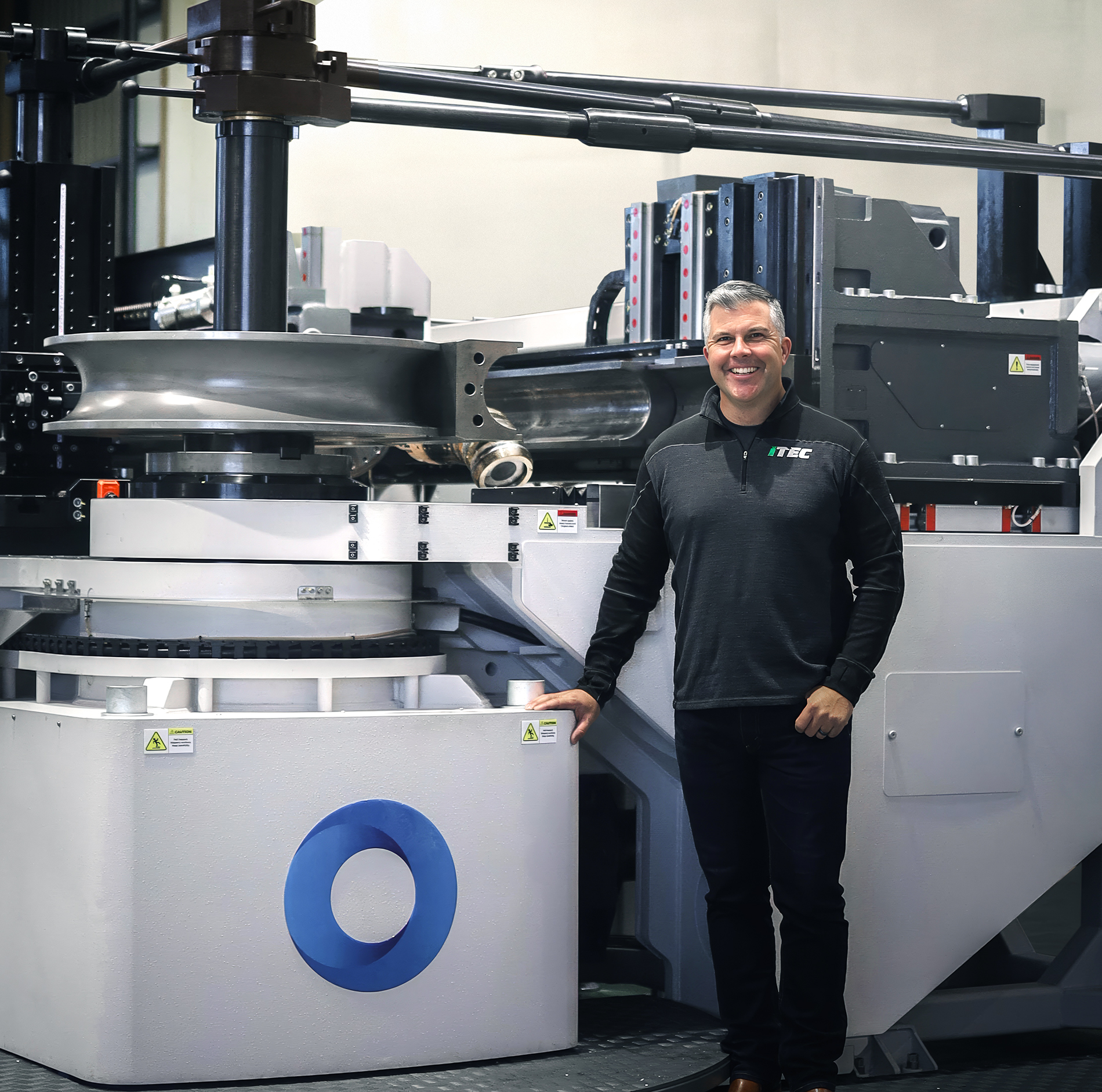
You can run production bending with fewer skilled operators by moving the skill into the machine, the program and the process. Stored setups, offline programming, standard tooling and automated loading now do much of the work that once took years of operator experience.
The shortage is real. It is the challenge ITEC hears about most often in customer shops.
Where the skill moves
| Task that used to need an expert | What handles it now |
|---|---|
| Setting up tooling and machine positions | Settings stored in the part program and recalled at changeover |
| Working out feed, rotation and bend angle | Bend data pulled from the CAD model |
| Trial bends to dial in a new part | Offline simulation before the first tube is loaded |
| Correcting angles for springback | Measured parts fed back into the program as corrections |
| Loading and unloading every tube | Magazines, loaders and robots |
Six ways to get there
1. Choose controls that store every setting
On an all-electric bender, every axis position lives in the program. Assuming no tooling problems, a new part can be set up in 30 minutes or less, with no hand tools used to adjust the machine (The Fabricator).
2. Program offline from CAD
Pull bend data from the 3D model instead of measuring by hand. Simulation software lets programmers build production-ready programs offline, without trial bends on the machine. See from SOLIDWORKS design to bend data.
3. Standardize tooling and setup sheets
Even with CNC, the tools make the bend. Many operators lean on machine features to get adequate parts instead of mastering tooling setup (The Fabricator). Write down a standard setup for every tool set and keep it with the tooling.
4. Close the loop on springback
Measure the first parts of each batch and feed the corrections back into the program. Many controls store corrections by material, so the next batch starts closer. See how to control springback.
5. Automate loading and unloading
A magazine or loader keeps the machine running while one person handles inspection and other work. Full cells can let a single operator bend and process parts safely (ITEC case studies). See when to automate with a robotic cell.
6. Train a few people deeply
Fewer skilled operators does not mean none. Train one or two people to own tooling, programs and troubleshooting. Everyone else can run proven programs.
Common questions
Do we still need an experienced tube bender?
Someone should own the process. That person sets standards, solves new problems and trains others. The goal is not to remove expertise, but to stop depending on it for every part.
How long does operator training take?
It depends on the machine, the parts and the person. Ask your supplier what training comes with installation and what follow-up training costs.
Does software replace tooling knowledge?
No. Software gets the numbers right. Tooling setup still decides bend quality, which is why standard setups matter.
Plan it with ITEC
Every machine ITEC delivers comes with TubeWorks software, and ITEC trains operators at installation. Book an introductory meeting to plan production around the team you have.