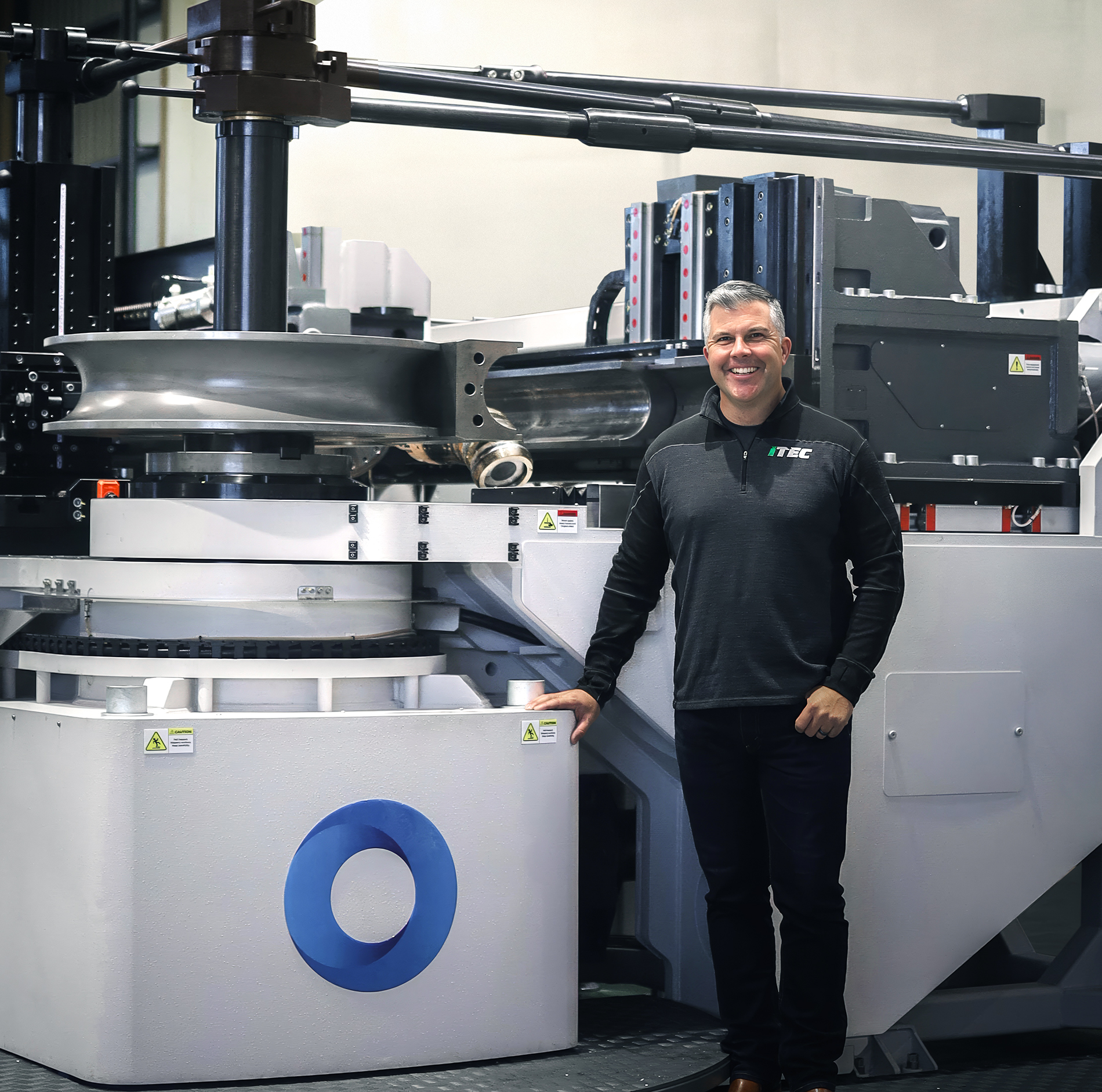
Rotary draw bending is the right starting point for most production parts, since it is the most common and most controllable method. Choose roll bending when a part needs only large, sweeping radii. Choose freeform bending when a part has many or changing radii that would each need their own fixed bend die.
The methods side by side
| Method | How it works | Best for | Limits |
|---|---|---|---|
| Rotary draw | The tube is clamped to a bend die and drawn around it. The die sets the radius | Precise, repeatable bends from tight to moderate radii | One radius per tool set, and a straight section between bends for clamping |
| Mandrel bending | Rotary draw with a mandrel inside the tube supporting the wall | Thin wall and tight radius bends that would wrinkle or collapse | More tooling and more setup |
| Roll bending | Rolls push the tube into a gradual curve | Large radii, arcs, rings and coils | Cannot make tight bends |
| Freeform bending | The tube is pushed through a die that moves to set the radius as it goes | Many radii in one part, variable curves, complex 3D shapes | Specialized machines, and not the first choice for the tightest radii |
| Compression and ram bending | The tube is pressed around a form | Simple bends, repair work, low cost | More flattening and less control than rotary draw |
Rotary draw bending
Rotary draw is the most common method for production tube bending (The Fabricator). A clamp holds the tube against a bend die, a pressure die keeps it in place, and the bend die rotates to form the bend. CNC rotary draw benders add programmable control of feed, rotation and bend angle, so complex parts repeat from one run to the next.
Rotary draw needs more tooling than other methods, since every radius needs its own bend die. It also needs a straight section of tube between bends so the clamp has something to grip (The Fabricator).
Mandrel bending
Mandrel bending is not a separate machine type. It is rotary draw bending with a mandrel inside the tube that supports the wall through the bend. Rotary draw is the only method that can use a mandrel (The Fabricator). You need it when the wall is thin relative to the diameter or the radius is tight.
Roll bending
Roll bending suits parts that only need large radii (The Fabricator). There is no fixed bend die, so one set of rolls can make many radii. Typical uses include coils, large sweeps, structural arcs, handrail curves and rings.
Freeform bending
Freeform bending forms the radius by moving the die as the tube passes through. One machine can make a long, sweeping curve and a tighter section in the same part without a tooling change. It suits parts with many radii and designs where a fixed die for every radius would cost too much. ITEC partner Dynobend specializes in fully electric freeform bending.
Machines that combine methods
Some systems combine rotary draw and roll bending on one machine (The Fabricator). That lets one part carry tight bends and large arcs without moving to a second machine.
Common questions
What does 2D mean in tube bending?
It describes how tight a bend is. The centerline radius divided by the tube’s outside diameter gives the D of bend. A 2 inch tube bent on a 4 inch centerline radius is a 2D bend. Lower numbers are tighter and harder.
Do I need a mandrel?
It depends on the wall thickness, the diameter and the radius together. Thick wall on a generous radius often bends cleanly without one. Thin wall on a tight radius usually needs a mandrel and a wiper die. See how to prevent wrinkles.
Can one machine do all of these?
Not all of them, but many machines combine two. Start from your parts. If most of your bends are tight and precise, start with rotary draw and add roll capability if large arcs come up often.
Find the right method with ITEC
ITEC represents six manufacturers that cover every method in this article. We match the method to the part. Book an introductory meeting.