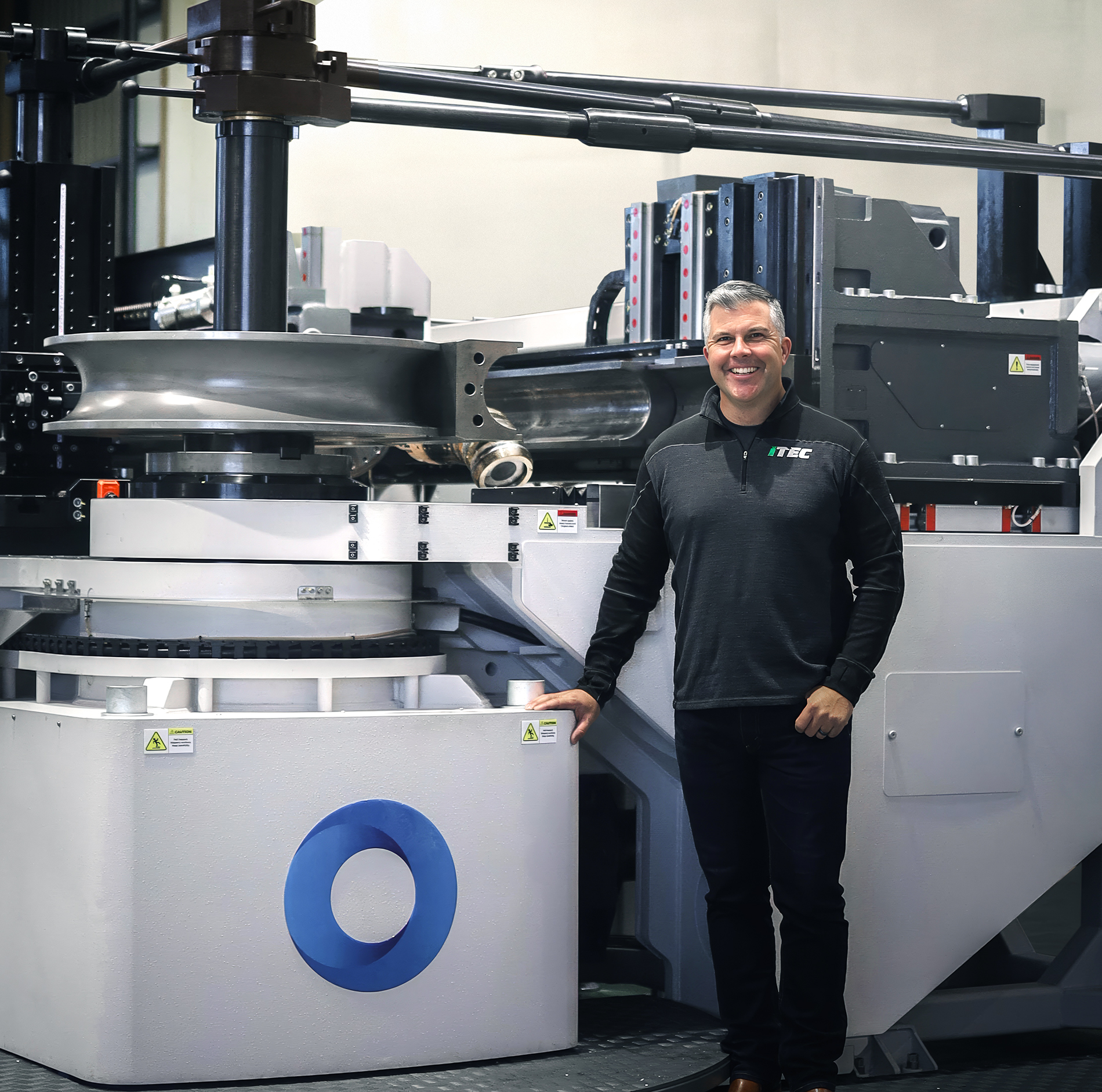
A twin-head bender has two bend heads that work on the same tube at the same time, usually one at each end. It makes sense when parts are long, bent at both ends or symmetrical, and made in high volume. In those cases it can cut cycle time and labor sharply compared with a single-head machine.
How a twin-head bender works
A single-head machine bends one end, then feeds and rotates the tube to reach the next bend, often all the way along the part. A twin-head machine holds the tube in the middle and bends both ends together, often as mirror images. Long parts never need to swing around the machine, which saves time and floor space.
A real example
Briggs & Stratton put its first OMG twin-head CNC bender into production and found it matched the output of three horizontal CNC benders while needing fewer operators. Flexible programming and easy tooling changes cut scrap and made the robot welding downstream run more smoothly. The company went on to buy five more units (ITEC case studies).
Twin-head or single head
| Question | Twin-head fits when | Single head fits when |
|---|---|---|
| How many parts? | High, repeat volumes | Low to medium volumes or many one-offs |
| Where are the bends? | Near both ends of the tube | Spread along the length |
| What shape? | Symmetrical or mirror-image parts | Asymmetric parts with varied geometry |
| How long? | Long parts that are awkward to rotate | Short to medium parts |
| Labor goal? | Fewer operators per part | Flexibility across many parts |
Parts that often suit twin-head bending
- Frames with bends at both ends.
- U-shaped and handle-style parts.
- Seat and furniture frames.
- Symmetrical parts for equipment, appliances and vehicles.
Trade-offs to weigh
- A twin-head machine is built for a type of part. It is less flexible across very different geometries.
- Both heads need tooling, so tooling cost rises.
- The machine needs room for the full part length.
Common questions
Can a twin-head bender make asymmetric parts?
Often, within limits. Capabilities vary by machine. Ask the builder to show your actual part bent on the machine before you buy.
Does twin-head help downstream processes?
It can. Consistent parts make welding, assembly and automation easier, as the Briggs & Stratton example shows.
Is a twin-head the same as two machines?
No. Both heads work on one tube in one cycle, controlled by one program. That is why one machine can match the output of several single-head machines on the right part.
Check the fit with ITEC
ITEC represents OMG, which specializes in twin-head bending. We will tell you plainly whether your parts suit twin-head or a single head. Book an introductory meeting.