Automate a bending cell when you run steady volumes on repeat parts and labor, not machine speed, limits your output. Start with automatic loading and unloading. Add a robot for handling and secondary operations once your parts, tooling and corrections are proven.
Signs automation will pay
- The bender waits on an operator to load the next tube.
- One person spends the shift loading and unloading instead of checking parts.
- Parts go to a second station for cutting, end forming or inspection.
- You cannot hire enough operators for the shifts you need.
- Downstream processes such as robot welding need consistent parts.
Levels of automation
| Level | What it adds | Good fit when |
|---|---|---|
| 1. Manual loading | An operator loads and unloads every tube | Low volume or very high mix |
| 2. Automatic loader | A magazine feeds tubes into the machine | Long runs where loading limits output |
| 3. Automatic unloading | Finished parts are removed and stacked or dropped into bins | Parts that are easy to collect and count |
| 4. Robot handling | A robot loads, unloads and presents parts to the next step | Heavy or awkward parts, or parts that must be placed precisely |
| 5. Full cell | Bending, secondary operations and inspection in one guarded cell | High volume part families with stable designs |
What one operator can run
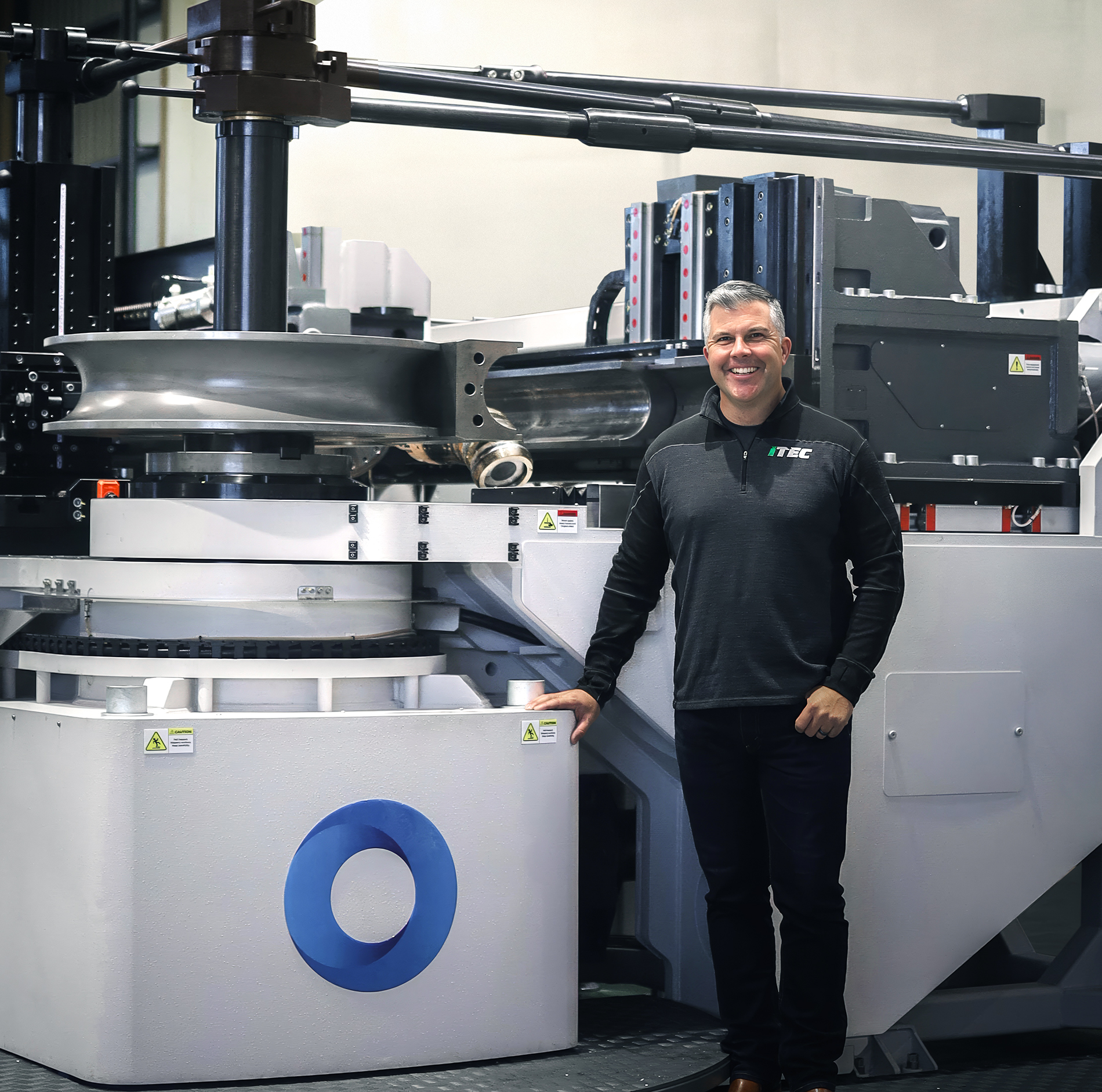
ITEC has worked with Star Technology and MTS to build work cells that let a single operator bend and process tubular parts safely, reliably and efficiently (ITEC case studies). At Briggs & Stratton, consistent parts from a twin-head bender also made the robot welding downstream run more smoothly (ITEC case studies).
Prove the process first
Automation repeats whatever the process does, good or bad. Before adding a robot, make sure these hold steady.
- Parts bend within tolerance across batches and material lots.
- Springback corrections are stored and stable.
- Tooling setups are standard and documented.
- Incoming tube is consistent in length, diameter and straightness.
- Designs are not changing every week.
Plan the cell around the part
- How will each tube be presented to the machine?
- How will the robot grip a bent part without marking it?
- Where do finished parts go, and how are they counted?
- Which secondary operations belong in the cell?
- How will people enter the cell safely to change tooling?
Common questions
Robot or dedicated loader?
A dedicated loader is simpler and cheaper for straight tube feeding. A robot earns its place when parts need handling after bending or must move between several operations.
Can a cell handle a high mix of parts?
Yes, but it is harder. Stored programs, multistack tooling and quick-change grippers help. Start with your most stable part family.
Do we need a robot programmer on staff?
Someone on site should be able to make small changes and restart the cell. Larger changes can come from your supplier or integrator.
Plan a cell with ITEC
ITEC can scope a cell from a single loader to a full line, and tell you plainly whether automation will pay for your parts yet. Book an introductory meeting.