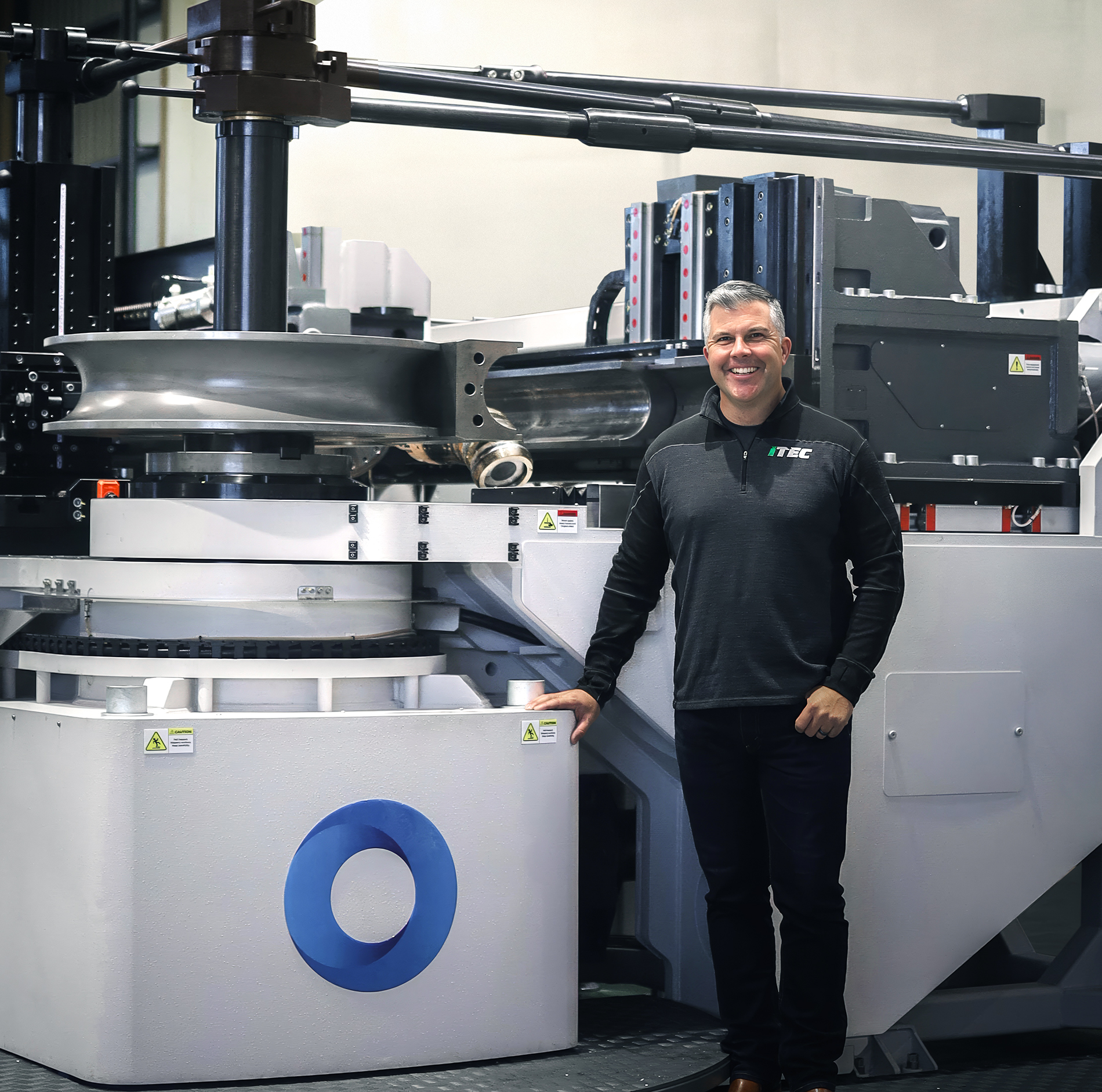
A single-stack bender holds one set of tooling, so it suits parts with one bend radius. A multistack bender holds several tool sets stacked on the bend head, so it can bend more than one radius in a single part and switch between part numbers without changing tooling.
How multistack works
Each stack is a complete tool set for one radius, with its own bend die, clamp die and pressure die. Between bends, the machine shifts the tube to the level of the next stack and keeps going. A part with a 2D bend, a 3D bend and a roll-formed arc can come off the machine in one cycle.
Bend direction adds to this. A machine that bends both left-hand and right-hand by rotating its head can effectively double the number of tool stacks available at one time (The Fabricator).
Side by side
| Factor | Single stack | Multistack |
|---|---|---|
| Radii per part | One | Several |
| Changeover between part numbers | A tooling change when the radius changes | Often none, if the tooling is already on the head |
| Machine and tooling cost | Lower | Higher |
| Tool design | Simple | Stacks must clear each other and the part |
| Best fit | Long runs of one-radius parts | Mixed radii, part families and frequent changeovers |
When multistack pays for itself
- Your parts have two or more different bend radii.
- Parts are bent on one machine today and finished on a second.
- You run many part numbers that share a few radii.
- Changeover time eats into your shifts.
When single stack is enough
- Most parts use one radius.
- Runs are long and changeovers are rare.
- Budget is tight and the parts are simple.
Plan the stacks around your parts
List every bend radius across the parts you plan to run, then group parts that share radii. That shows how many stacks you need and which parts can run together without a tooling change. Add room for the parts you expect in the next few years.
Check tool interference early. On a multistack head, the tooling for one radius sits right next to the tooling for another. Long parts or tight bends close together can hit the stack above or below. Ask the builder to simulate your hardest part.
Check tooling compatibility too. A new machine whose tool mounts do not match your existing tooling can cost more than you planned (The Fabricator).
Common questions
Is multistack only for high volume?
No. Multistack often pays off most in high-mix shops, where saving a tooling change on every job adds up quickly.
Can a multistack machine also roll bend?
Some can. Combining rotary draw stacks with a roll bending stack lets one part carry tight bends and large arcs (The Fabricator).
Does multistack make setup harder?
Initial setup takes more planning, since the stacks must be designed together. After that, changeovers are usually faster because the tooling stays on the machine.
Size it with ITEC
ITEC offers single and multistack machines from AMOB, Herber and Dynobend. Send us your parts and we will show you how many stacks they really need. Book an introductory meeting.