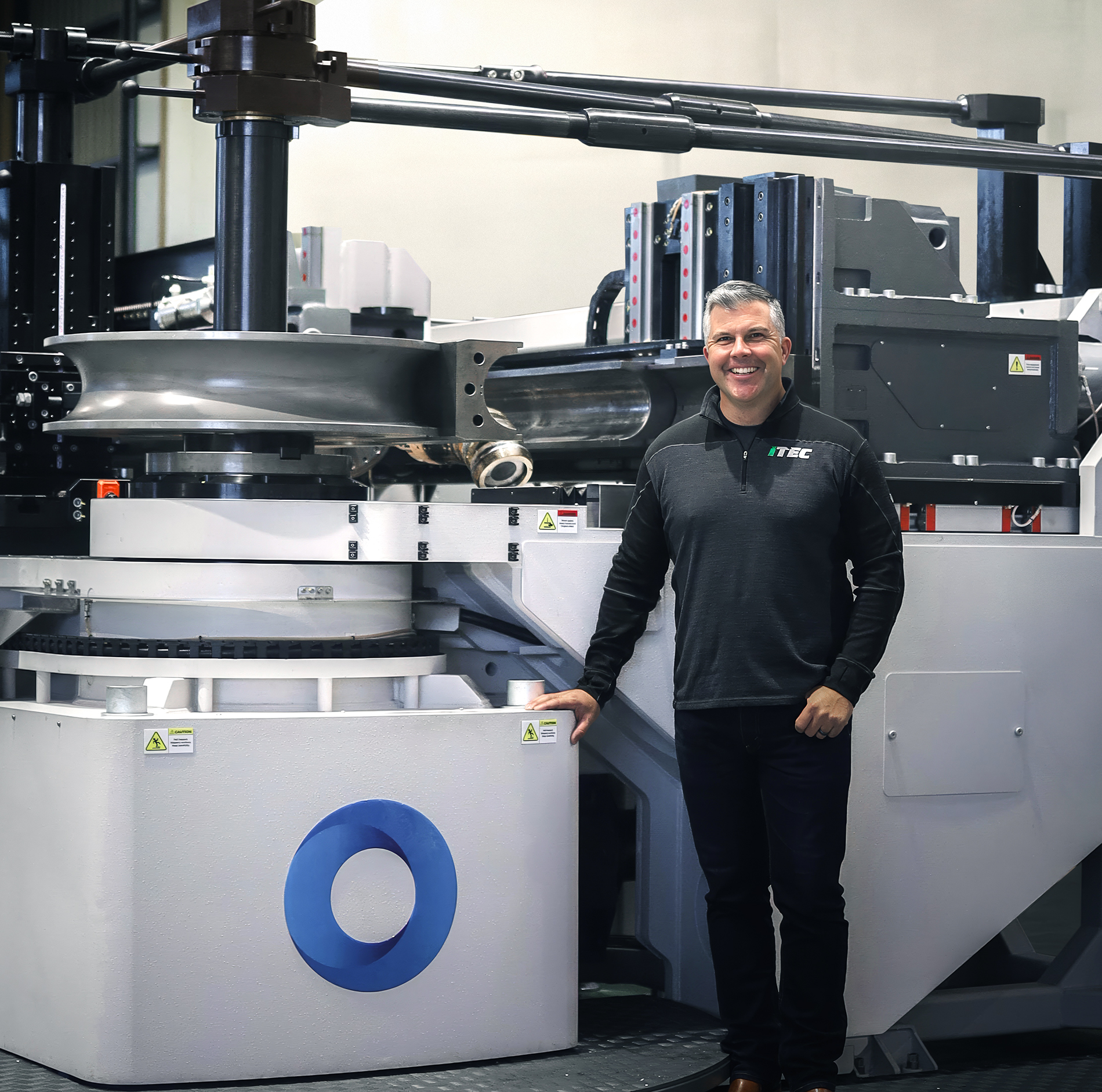
Bring tube bending in-house when outsourced parts cost you more in price, lead time and control than owning a machine would. For most manufacturers the tipping point comes from steady volume on repeat parts, lead times that hold up their own shipments, or a part no supplier wants to quote.
This guide covers the signs it is time, when to keep outsourcing, and how to run the break-even math with your own numbers.
Signs it is time to bring bending in-house
- You buy the same bent parts every month and the volume is steady.
- Supplier lead times delay your own shipments.
- You carry extra inventory to protect against late deliveries.
- Design changes take weeks to reach the parts you receive.
- Suppliers struggle with a part, or decline to quote it.
- Quality problems on bent parts cause rework on your line.
Shops that make the move usually name the same gains. They control their own schedule, carry less inventory and turn design changes around in days instead of weeks.
Wisconsin Steel & Tube outsourced one bent part for close to ten years. Several vendors declined to quote it. After adding an AMOB eMOB150, the company made the part in-house and made it better than the parts it had been buying (ITEC case study).
When to keep outsourcing
- Your volume is low or irregular.
- Every order is a new part that needs new tooling.
- You have no floor space or people to run a machine.
- Your parts span sizes no single machine can cover.
Many shops do both. They bring their high-volume part families in-house and keep low-volume or very large parts with a supplier. That split often pays for the machine fastest.
Run the break-even math
Compare what you spend on outsourced parts today with what the same parts would cost to make. Use a full year of real numbers. The table below shows the cost lines to include and a worked example.
The example numbers are for illustration only. They are not a quote. Your part prices, labor rates and machine choice will differ.
| Cost line | Outsourced | In-house |
|---|---|---|
| Parts bought, 30,000 a year at $7.50 | $225,000 | None |
| Freight and expediting | $12,000 | None |
| Carrying extra safety stock | $8,000 | None |
| Tube material at $3.00 a part | Included in price | $90,000 |
| Scrap allowance of 3 percent | Included in price | $2,700 |
| Operator time, half of one full-time role | None | $35,000 |
| Service and maintenance | None | $6,000 |
| Energy and floor space | None | $5,000 |
| Machine, tooling and installation of $345,000 spread over 7 years | None | $49,286 |
| Total per year | $245,000 | $187,986 |
| Cost per part | $8.17 | $6.27 |
In this example the shop saves about $57,000 a year after counting the cost of the machine. Leaving out the machine cost, the in-house cash cost is $138,700 against $245,000 outsourced. That saves $106,300 a year in cash, which pays back the $345,000 investment in about three and a quarter years.
Two things change the math in your favor. Section 179 can let you deduct the machine in the year it goes into service, which shortens payback after tax (AFG). The second is everything the table leaves out, such as faster design changes and orders you can now quote. See what a CNC tube bender really costs for the full price picture.
Common questions
How many parts a year justify a CNC bender?
There is no single number. It depends on your part price, your cycle time and how many part families share the machine. Run the table above with your own data. Shops often find that one or two high-volume part families pay for the machine.
Can we start with a manual or NC bender?
Yes, for simple parts at low volume. A manual or NC bender costs a fraction of a production CNC machine and suits prototypes and short runs. Move to CNC when volume, tolerances or part complexity outgrow it.
What if nobody on our team has bent tube before?
That is common for first-time buyers. Modern CNC controls store every setting in the program, and a good supplier trains your operators during installation. Plan for one person to own tooling and setup so the knowledge stays in-house.
Talk it through with ITEC
ITEC helps manufacturers run this math with real part data before anyone recommends a machine. We represent six manufacturers, so the answer can be a Best-Fit Bender, or a reason to keep outsourcing for now. Book an introductory meeting.